Summary
The manual gearbox is disappearing from what dealers sell, and it is disappearing fastest at the top of the market.
Five years ago, nearly six in ten used cars sold by dealers had a manual transmission. Today, the figure is just one in three.
An analysis of dealer listings by AutoUncle found that manuals accounted for 34% of used-car sales in the second quarter of 2026, down from 58% in the same period of 2021. The quarter covers 813,507 cars sold by dealers, and 34% is the lowest reading in a six-year series that begins in 2020.
Electric cars are not the explanation. Over the same five years the manual share of petrol and diesel cars alone fell from 61% to 47%, and among those cars the manual has been the minority choice in every month since February 2026.

On a small budget, the scarce car is now the automatic
The gear stick has not disappeared from every part of the market. It has retreated into the cheapest cars, and that has reversed which transmission is hard to find.
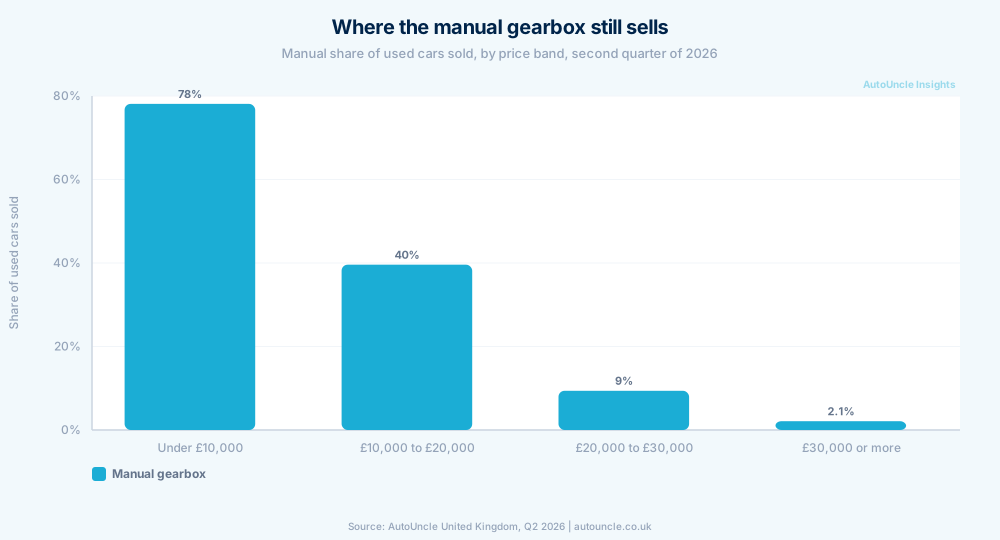
Below £10,000, 78% of used cars sold still had a manual gearbox. Between £10,000 and £20,000 the share falls to 40%, between £20,000 and £30,000 to 9%, and above £30,000 to 2.1%.
More than nine in ten manuals sold during the quarter changed hands for less than £20,000. The median manual car cost £11,990.
The consequence runs the opposite way to the headline. A buyer shopping below £10,000 has a wide choice of manuals and a narrow one of automatics: only 22% of the cars sold in that band had an automatic gearbox. Above £20,000 the position is reversed, and above £30,000 the manual has effectively ceased to be an option.
Each new generation brings fewer gear sticks
The price pattern is largely an age pattern, because cheaper used cars are older ones. Comparing cars by the year they were built shows where the change originates.
Among used cars from 2016, 61% were manual. For cars from 2020, the figure had fallen to 41%. Only 16% of used cars from 2025 had a manual gearbox.
The same gradient runs through petrol and diesel cars on their own, though more gently: 63% of 2016 cars against 30% of those from 2025.
This is the mechanism behind the headline figure. Dealers sell the cars that were built, and manufacturers have been fitting fewer manual gearboxes each model year. As those newer cars work through the second-hand market, and as the most manual model years pass out of the ten-year window this analysis covers, the measured share will keep falling regardless of what buyers prefer.
| Year | All used cars | Petrol and diesel only |
|---|---|---|
| 2016 | 61% | 63% |
| 2017 | 56% | 58% |
| 2018 | 51% | 54% |
| 2019 | 47% | 51% |
| 2020 | 41% | 49% |
| 2021 | 34% | 46% |
| 2022 | 30% | 46% |
| 2023 | 31% | 45% |
| 2024 | 24% | 36% |
| 2025 | 16% | 30% |
Learner drivers are already adapting
The change is visible among new drivers too, on a different measure and a different population: driving tests taken, rather than cars sold.
More learners are testing in automatic cars. DVSA recorded 26% of car driving tests taken in automatics in 2024/25, against 23% the year before and 6% in 2012/13.
An automatic-only licence now gives access to 66% of the used cars dealers sell, against 42% five years ago. The majority has switched sides: five years ago that licence ruled out most of the market, and today it rules out a third of it.
Drivers who learn in a manual can still use either transmission, but the practical advantage of doing so narrows as automatics take a growing share of what is for sale.
Not gone, but no longer the default
Manual cars will remain available for years, because so many are already on the road. The parc changes far more slowly than the sales mix, and enthusiasts will continue to seek manuals out for the greater sense of control they offer.
But as an everyday choice made without thinking about it, the manual is finished. It is becoming a characteristic of a particular kind of car, older and cheaper and smaller, rather than a default fitted across the range.
“The manual gearbox is not disappearing overnight, but it is clearly nearing the end of its time as the normal choice,” says Mads Noergaard, market analyst at AutoUncle. “What catches my eye is which way the scarcity now runs. On a small budget, the hard car to find is the automatic, and that is the one nobody plans for.”
Source note
The analysis is based on AutoUncle dealer listings for used cars sold in the United Kingdom, up to ten years old at the time of sale, tracked quarter by quarter from 2020 to the second quarter of 2026, with the second quarter of each year from 2021 to 2026 charted and monthly figures from 2024 through June 2026. The second quarter of 2026 covers 813,507 cars. Transmission is taken from the specification recorded on each listing. Price bands, price figures and figures by year of the car cover the second quarter of 2026. Figures describe cars sold by dealers, not the national car parc, which remains far more manual. New cars, leasing cars and private sales are excluded. Driving-test figures are per DVSA and describe tests taken, a different population from the cars in this analysis. AutoUncle is the European standard for car valuations and price comparisons, aggregating used-car data from thousands of dealers across 14 European markets.