
Summary
Used electric cars have spent much of the past few years becoming cheaper. This spring, that direction changed.
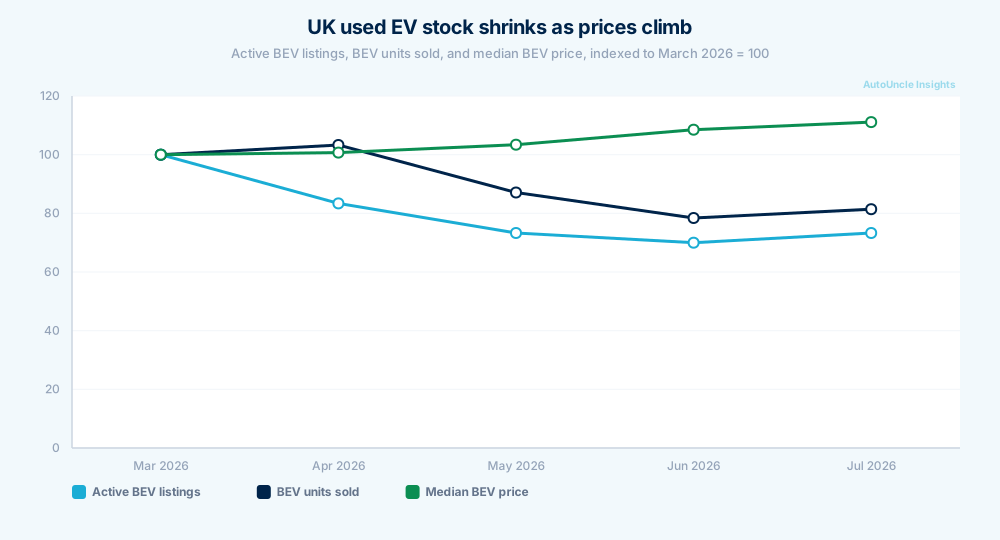
Between March and July 2026, the median advertised price of a used battery-electric car in the UK rose 11%, from £18,895 to £20,998. At the same time, active BEV listings fell 27%. But perhaps the most important development is what happened to transactions: AutoUncle’s indexed data shows used-BEV sales falling by around 19% from their March level by July. That combination, prices up and sales down, tells a more interesting story than falling stock alone.
The figures do not prove that higher prices caused sales to fall. But they are consistent with a market that initially became supply-constrained and may now be running into a price ceiling.
A shortage can push prices higher - until buyers push back
The first part of the development is relatively straightforward.
Used-EV stock fell much faster than the wider used-car market. While active BEV listings dropped 27% between March and July, total UK used-car listings across all fuel types declined by only 4%. Electric cars consequently went from 13% of available used stock in March to 10% in July.
When fewer cars are available but buyers are still looking for them, sellers gain pricing power. The cars that do reach the market can command stronger prices, particularly when dealers are competing to secure desirable, correctly priced stock.
That appears to have been happening during the spring.
But higher prices also change the equation for the customer.
An 11% increase in just four months is substantial in a used-car market. Once that increase is passed through to retail asking prices, some buyers will postpone a purchase, widen their search or consider another powertrain.
That is where the July sales number becomes important.
Used-BEV sales fell by around 19% from March to July. In other words, the market has not simply experienced fewer cars for sale and higher prices. It has also experienced fewer transactions.
The fact that sales fell less sharply than stock, 19% versus 27%, suggests underlying appetite for used EVs has not disappeared. There are simply fewer cars available to satisfy it. But the simultaneous rise in prices raises the possibility that scarcity has now pushed parts of the market beyond what buyers are prepared to pay.
The market may therefore be moving from a supply constraint to a supply-and-affordability constraint.
Used EV buyers have become accustomed to falling prices
There is another reason why the recent price increase matters particularly for electric cars.
Used EV prices have been through several years of unusually heavy depreciation. AutoUncle’s separate analysis of 2022 cars found that electric models originally advertised at around £49,700 had fallen to about £18,500 by 2026, a decline of 63%. Equivalent petrol cars declined by 38% over the same period.
That decline was painful for owners, but it also did something important for the used market: it made electric cars accessible to a much larger group of buyers.
A used EV that once sat well above the price of an equivalent combustion car increasingly became a credible alternative.
That makes the latest reversal significant. Buyers who entered the market because used EVs had become markedly cheaper are likely to be sensitive when prices move back in the opposite direction.
An 11% rebound does not reverse years of depreciation. But it can be enough to change the economics of an individual purchase, particularly when monthly payments, insurance and uncertainty around future residual values are all part of the decision.
The decline in sales therefore should not automatically be interpreted as a loss of interest in electric cars. It may instead be the first indication of how much more buyers are prepared to pay before demand begins to soften.
Sourcing used EVs has become harder
Behind the price movement is a wider sourcing problem.
Used-BEV demand is no longer growing only in a handful of mature EV markets. Across 11 European markets tracked by AutoUncle, used battery-electric transactions were 84% higher year on year in April 2026. Germany more than doubled, with growth of 126%, while Sweden and Portugal both moved above a 20% used-BEV share for the first time.
That does not prove that stronger continental European sales caused the UK stock shortage. The UK is also a distinct right-hand-drive market, so used-car supply is not freely interchangeable with continental Europe.
But the broader development matters.
Electric cars are increasingly being absorbed by used-car markets rather than sitting in oversupply. For dealers and remarketers, the environment has shifted from one characterised by rapid EV depreciation and excess stock towards one where good used BEVs can be harder to replace.
That makes sourcing more competitive and gives sellers less reason to discount.
The result can become self-reinforcing for a period: stock falls, procurement becomes harder, prices rise and dealers become more reluctant to sell cheaply because replacing the car may cost more.
But such a cycle has limits.
The sales decline may be the mechanism that brings the market back into balance
The important question now is what happens next.
If higher prices are starting to constrain sales, the market has its own mechanism for correcting the imbalance.
Cars remain available for longer. Stock begins to rebuild. Dealers face less pressure to secure replacement vehicles immediately. Competition for wholesale stock eases. And eventually retail prices stop rising, or begin to soften.
That would make sourcing easier again and could bring buyers back into the market.
There may also be additional supply coming through the system.
The timing of the current squeeze follows a record March 2026 for new EV registrations. March is one of the UK’s number-plate change months, when large volumes of new-car activity can subsequently generate part-exchange stock for the used market.
But if supply does begin to improve while sales remain below their spring peak, the balance could change relatively quickly.
The most likely next phase is therefore not necessarily another sharp rise in used-EV prices.
Instead, the market may begin to normalise.
More available cars would make sourcing easier for dealers. A less aggressive procurement market would remove some of the upward pressure on retail prices. And more stable, or slightly lower, prices could once again encourage buyers who have been sitting on the sidelines.
If supply does not recover, prices may remain firm, but the July sales figures suggest there is a limit to how far the market can move upwards before transaction volumes suffer.
The key number is no longer stock
Falling stock explains how the latest phase of the UK used-EV market started.
But sales may tell us how it ends.
A 27% reduction in available BEVs created the conditions for prices to rise. An 11% price increase followed. Now sales are around 19% below their March level.
The data cannot tell us definitively whether buyers are walking away because prices have risen or simply because fewer suitable cars are available. Most likely, both forces are now operating at the same time.
That distinction matters.
If this were simply a collapse in EV demand, prices would normally be expected to weaken alongside sales. Instead, prices have risen.
What the market appears to be experiencing is a shortage that has pushed prices upwards, followed by the first signs that buyers will not absorb those increases indefinitely.
For dealers, that could ultimately be good news.
Softer transaction volumes should gradually take some heat out of procurement. If used-BEV supply improves at the same time, the market can move back towards equilibrium: more cars available, easier sourcing, less upward pressure on prices and, eventually, stronger sales.
After several years in which falling EV values dominated the discussion, the UK used-electric market may now be discovering the opposite problem.
Used EVs have become scarce enough to get more expensive. The next question is whether they have also become expensive enough to slow the market down.
About the data
AutoUncle is the European standard for car valuations and price comparisons, aggregating used-car data from thousands of dealers across 14 European markets. Listings and price figures are based on dealer listings for battery electric cars in the UK between March and July 2026, excluding new cars, leasing cars, and private sales. Price data is trimmed at the 5th and 95th percentile per quarter to remove extreme outliers, and vehicles older than ten years are excluded. Sales figures are estimated from the same dealer-listing dataset, based on how quickly listings turn over, rather than from verified transaction records. The European comparison references a separate AutoUncle analysis of 11 markets published in May 2026, using the same dealer-listing methodology.
Source: AutoUncle UK, March to July 2026 | autouncle.co.uk
Press contact
Mads Noergaard, Market Analyst, AutoUncle. mads.lauridsen@autouncle.com


