Based on a conversation with Johan F. Schjødt, co-founder of AutoUncle.
A car enquiry arrives at 22:40 on a Tuesday. Someone has spent their evening on it, comparing three cars, working out what their current one is worth, wondering whether they can justify the monthly payment. Then they write to a dealer and go to bed.
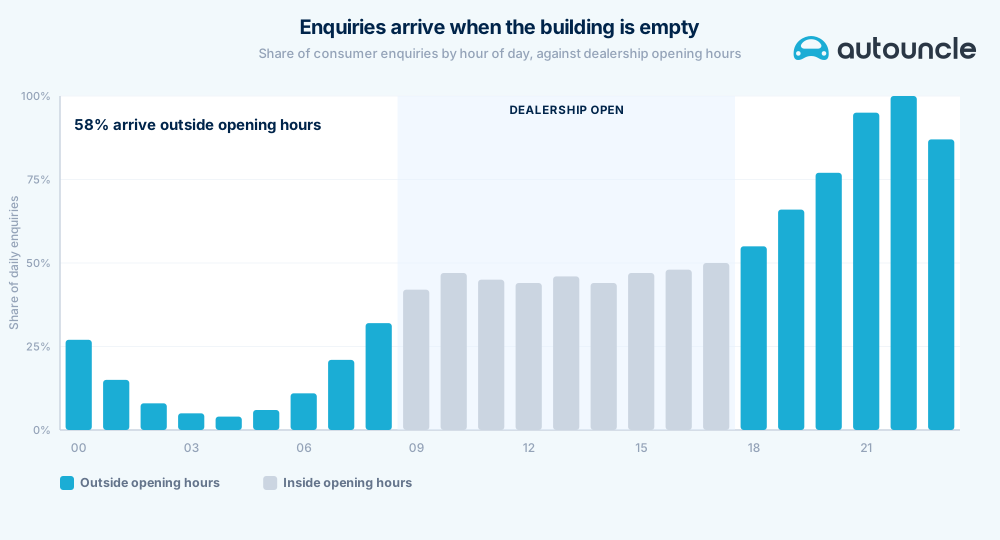
At the dealership, nobody is there. The showroom opened at nine and closed at six. The enquiry sits in an inbox until morning, and by then it is behind forty others.
This is not the exception. 58% of consumer enquiries arrive outside opening hours, peaking between 21:00 and 23:00. And when AutoUncle asks the people who sent them, 26% say they had still received no reply two days later.
That is not a technology problem. It is a gap.
Two gaps, actually
“There is a gap. It can be a gap in time between when a consumer is doing their work and when the dealer is at work. It can also be a gap in that the dealer still lives very much in an offline world. That’s why they work physically. And consumers very much in an online world.”
Both parties are behaving completely reasonably, says Schjødt. They simply never overlap.
“Any of these gaps, being time-wise or space-wise, is calling for someone to help bridge it. Because right now, the frustration of the gap when it’s not closed is to see all the waste and all of those opportunities that’s falling to the ground.”
Nobody logs that waste and nobody is blamed for it, which is why it happens again the next evening. It is the most under-measured number in automotive retail.
The lead is not thin. The email is.
Here is the part the industry has consistently got wrong.
“It is generally hard for dealerships to hire really good salespeople. Just like any restaurant is having trouble finding a good chef or good servants, there is an issue. And a lot of the sales work in a dealership is responding to what might be perceived as low-quality leads.”
“Is this car still available.” Three words, no name, no context. A salesperson with forty of those and a limited day picks the ones with more to work with. That is not laziness, it is rational triage on the only signal available.
But the signal is measuring the wrong thing.
| What the dealer sees | What is actually there |
|---|---|
| "Is this car still available?" No name. No subject. Five words. Forty of these in a day, and this is the one that gets skipped. |
|
They are being filtered out for their register, not their readiness.
“Behind that low-quality lead is a real human. And maybe that human just didn’t understand what to write in an email to a dealer to be taken seriously. But nevertheless, it’s someone who was reaching out on a very expensive product like a car, and who has already thought about spending a huge amount of money. Given that, it’s actually a very poor experience if you’re not responded to.”
Schjødt is equally clear that the salesperson is not the villain here.
“I can also totally understand things from the seller side. If you get a lot of those poorly written emails and you are to prioritise your daily work, it can be hard to prioritise those requests where you feel you’re starting with something very skinny. Then you will pick leads that are more meaty, where there’s more on the bone.”
So the question is not how to make salespeople answer faster. It is how to stop asking a human to guess, from a thin email, which stranger is serious.
Not a chatbot in a costume
Most AI sold into this industry is sold on the promise that the customer will not be able to tell. Seamlessness is the product.
Since 2 August 2026, that promise is not available in Europe. Article 50 of the EU AI Act requires that a person interacting with an AI system is told so, clearly, from the start of the first interaction, with fines of up to EUR 15 million or 3% of global turnover.
Schjødt’s position is that this is the right outcome regardless of the law.
“In a dream scenario, we could have humans responding to all our needs and questions as customers, basically anywhere. But the whole point is that there is a scarcity of human resource. So what do we prefer, as a consumer? Is it to wait maybe days for a human response? Or is it to have a specialised system helping you move on, when there is no option of getting that fast human response? I don’t see any issue in disclosing that it’s an AI. I think it’s about being transparent, and I think it’s a good thing.”
The honest comparison, in other words, is not AI versus a human. It is AI versus waiting two days for a human who was never going to be at their desk at 22:40.
Disclosure also makes the product better, because an assistant that is not maintaining a disguise can be honest about its own limits. It can say: the car is available, I can book you in on Saturday, and a colleague will talk to you about price. There is no character to break.
And the objection that a machine cannot have a useful conversation with someone who does not yet know what they want has it backwards.
“The whole idea is that having someone like the uncle helping the consumer by asking the relevant questions might actually help the consumer understand better what it is they’re looking for. It’s very hard to help someone who doesn’t know what they need. This back-and-forth conversation that is endlessly patient, and that can be tailored in really high quality with AI, can work wonders.”
He points at where the evidence already is:
“One of the most prominent use cases for AI is that people are using it for personal sparring and coaching. It might be sports coaching, or coaching on relationship issues, or anything. It just shows that people are really eager to have someone helping them work out the ups and downs of a situation. And that also applies to buying a car.”
What AI should not touch
CoDriver, AutoUncle’s AI assistant for dealer enquiries, deliberately does nothing on prices and offers, and nothing on test drives and handover. Those are not gaps waiting to be filled.
“Cars are still bought with emotions. They appeal to us because of the looks, how they feel. And that feeling takes something that’s tactile, something that’s visual, something you can listen to. Because a car is such a strong symbol of freedom, and that freedom is something that happens in the real world, I think the physical interaction with the car, and also the fact that it’s a really expensive item you’re buying, will in most cases lead to a process that ends up with something physical, offline.”
Simon-Kucher’s 2025 global study points the same way: 82% of buyers prefer to finalise their purchase at the dealership.
There is one exception worth noting, because it marks the boundary of the argument rather than weakening it:
“There are other cases where you need transportation, it might be a self-driving car to get you from A to B, where it doesn’t really make sense to go out and test drive and see the car. But that’s a different use case. When we’re talking about the car as my car, the asset I own, something that helps me with my lifestyle, I think offline will still be a thing.”
Which means the friction worth removing is not the emotional part. It is the correspondence, the chasing, the “is it still available”, the qualifying: the part nobody enjoys on either side.
Three markets, one job to be done
AutoUncle runs CoDriver in Denmark, Germany, and Italy: three markets that are not remotely alike.
“Anyone who has travelled across Denmark, Germany and Italy knows that cars are inherently different in our culture, in our way of doing business, but also in how digital we are, how good the internet connections are. But in that sense, it’s still the same. It’s a consumer wanting to buy a car or upgrade a car, trading in their existing car. So it’s the same job to be done, and it’s the same steps consumers are going through. It’s the same concerns they’re having.”
What differs are conditions, not substance, and the examples are practical rather than philosophical.
“It might be that there are some contextual conditions that differ. In Germany, where mobile internet connection is not as strong, it’s really important that the implementation is a bit more technically lightweight, so it doesn’t become slow because of the slow internet. That could be an example.”
Worth saying, because “European dealers aren’t ready for this” is usually a story about markets that are more alike than they look.
The measure is waste
Some of this has already arrived, on both sides of the transaction.
“It’s already happening to some extent. If you read online listings, it’s quite clear that often the images are manipulated with AI. It’s also clear that a lot of the listing text is already manipulated by AI. And having assistance that helps us, so there’s more time to go out and actually view the car and test drive, I don’t think that’s a bad thing. Because a lot of the issue right now is friction, and the gap I talked about.”
And the test is not response time.
“In the end, we can measure if it’s successful. And success looks like there’s less waste. That means fewer connections that go to zero and are lost on the ground, and that we have more happy dealers and more happy consumers.”
“Dealers will need to invest in the tech side, because consumers expect this. So it’s not really a choice, it’s how things are moving. And consumers will be much less forgiving in the future if you, as a dealership, are very slow to respond to requests on a big purchase like a car.”
The belief that will look embarrassing
Slow lead response is not news. It has been measured and complained about for a decade. On why it persists, Schjødt is blunt:
“The thing is that it continues to be a story because we haven’t found a solution until now. And I think that’s the big thing, that now there is actually a way to help solve this.”
Asked which belief dealers hold today will look foolish in three years:
“That would be if you don’t think an AI can do a good job in qualifying the enquiries you’re getting from consumers, and actually saving you a lot of time in the work, and actually making your work as a dealer more fun, because you are spending less time responding to leads that are maybe already too old.”
Note that the payoff he reaches for is not cost. It is that the job gets better: less of a salesperson’s day spent on leads too old to save, more of it spent with people who are ready, which is the part of the work anybody who chose this job actually wanted.
One thing, on Monday morning
“I would go in and see how many leads we got that we didn’t respond to, which is essentially opportunity cost. I think that’s the first thing: to understand the magnitude of this problem in my own dealer business.”
Not buy anything. Count.
That number is your opportunity cost, and almost nobody knows their own.
Sources
- Share of enquiries arriving outside opening hours (58%, peak 21:00-23:00): AutoUncle data, 2026.
- Share of consumers reporting no reply two days after enquiring (26%): AutoUncle lead survey, 2026.
- Product scope referred to above, automated response and qualification, with prices, offers, test drives, and handover left to people: CoDriver, AutoUncle.
- Preference for finalising the purchase at the dealership (82%): Simon-Kucher, Automotive Shoppers Take the Wheel, global consumer study, 2025.
- EU AI Act Article 50 transparency obligations, applicable from 2 August 2026: European Commission.