Summary
There is a particular way this usually starts. A dealer principal has been using ChatGPT in the evenings, drafting something, asking a question, being mildly impressed. They come away with a conviction that this matters to their business, and no idea where it goes.
“I think when dealers research for this, it’s probably due to some hype, that they can see it’s important. Maybe it’s because they are using AI privately, and they’re thinking about how it could be helpful for their business. But at this stage, a lot will have an unclear feeling that it might help their business, but not sure what the applications are.”
That is the honest starting position for most of the market. The industry’s answer to it, a list of seven things AI can do for your dealership, only makes it worse, because a list of possibilities does not tell you where to start. What does is a look at what is actually straining.
The two things underneath
Ask a dealer what hurts and you rarely hear “we lack artificial intelligence.” You hear two other things.
The first is people.
“It is generally hard for dealerships to hire really good salespeople.”
The second is work nobody wants and everyone has too much of: a steady arrival of enquiries of wildly varying quality, each one read, judged and answered by someone whose time is worth more than that.
“Another thing is also to automate some processes that feel heavy, dealing with leads of varying quality.”
The expensive mistake
“The issue can be if dealers, in the hype of AI, end up buying a tool which is an addition. It’s adding more stuff. Where AI is best is optimising and improving and, in some cases, taking over processes that already exist. That’s the key thing. It’s really important not just getting a new fantasy tool, but applying it to a specific problem and understanding this.”
A tool that is an addition looks like progress on the day it is bought. It has a dashboard, a login, settings somebody has to maintain. Three months later it is a tab nobody opens, and the work it was meant to help with is still being done exactly as before, plus the tool.
A tool that takes over is less exciting to buy and easier to notice afterwards, because something that used to be done by a person is no longer being done by a person.
Which leaves one question to ask before signing anything, and no vendor will hand it to you: does this add work to someone’s day, or take work off it?
Every tool you are offered is one of three: an addition, a takeover, or an elimination. The line is where you started: you lose time.
| Type | What it looks like | Time impact |
|---|---|---|
| Addition | A new dashboard and login, on top of the work you already do. | Costs you time |
| Takeover | Enquiries answered and qualified around the clock, without a person. | Saves time, every week |
| Elimination | The budget is settled in writing, so the viewing that would have led nowhere is never booked. | Saves time, hassle and cost |
The money is well spent on the bottom two. Most of it is spent on the top one.
Elimination is the row people miss. Some work does not get taken over, it stops needing to happen at all:
“Let’s say that you spend time showcasing a car where you could find out that the potential customer doesn’t have the budget for that car. So that is a way where you could save time as well.”
Nobody automated the viewing. It stopped needing to happen: the budget question was answered in writing on Tuesday, so the Saturday appointment for a car the buyer was never going to afford was never made. One salesperson keeps two hours, the buyer is not embarrassed, and the car stays on the forecourt for someone who can buy it. That is the largest return in the table above, and it never appears in a feature list. It is not a feature, it is an absence.
Chat is not the same as agentic
The reason so many dealers buy an addition is that they are picturing the wrong kind of AI. And they are picturing it because it is the kind they have met.
“It can be difficult to understand, especially if you’re mostly accustomed to AI chat and not to the agentic way we’re using AI.”
Chat AI produces text. You open a window, describe the task, read what comes back, copy it, paste it, send it, and log it. Every step around the text is still yours. Useful, but your process is unchanged. You have a faster way to draft things.
Agentic AI runs a workflow. It is connected to the inbox, the calendar and the stock list, and it takes the steps itself, in order, without being opened: the enquiry arrives, it is read, the missing information is requested, the reply comes back, the appointment is offered and written into the diary, and the result lands on a salesperson’s desk in a state they can act on.
The difference is not sophistication. One writes a message and hands it to you. The other completes the job. A human has to be present for the first; nobody has to be present for the second.
Which is why “which AI tool should I buy” is the wrong first question. A chat tool bought to solve an agentic problem will always disappoint, not because it is bad, but because it was never going to touch the process you were worried about.
| Chat | Agentic |
|---|---|
| You open it. You prompt it. It returns text. You do the work. | 22:47 the enquiry arrives. 22:48 the missing questions are asked. 03:15 an appointment is agreed. 08:30 it is handed to a salesperson. |
| Begins and ends with the person: nothing happens unless someone opens it. | The person appears once, at the end, with something they can act on. |
What can be taken over
Now the test is usable. Take the chain a dealership already runs when an enquiry arrives, read it, judge it, reply, chase the missing details, agree a time, prepare, meet, sell, hand over, and sort each link into the three.
Some of it is physical and stays that way.
“Obviously, the most physical process cannot be automated yet.”
The test drive, the walk around the car, the handover, the handshake. These are not gaps waiting for technology. They are where the sale actually happens.
The written and preparatory links are a different matter:
“Especially dealing with requests and inquiries from potential customers, the evaluation part, even if you have a solid system, indicating some offers and preparing things, interviewing the consumer, booking the appointments and the agreements and so on. A lot of this can easily be replaced and done very consistently to the satisfaction of the consumer.”
Read that last clause twice, because it contains the point most easily lost: consistently, to the satisfaction of the consumer.
Consistency, not speed
Every vendor in this category sells speed. Speed is real, but it is not the biggest change, and it is not the hardest thing for a dealership to manage on its own. Consistency is.
A salesperson qualifying an enquiry at 09:00 on a quiet Tuesday asks good questions, reads the message properly and replies in full. The same salesperson at 17:30 on a Friday with thirty-eight open cases asks fewer questions, skims, and replies to the ones that look promising. Same competent professional. Not the same output.
A process that has been taken over asks the same questions every time, of the promising enquiry and of the three-word one, on Tuesday morning and on Friday evening. For most dealerships that is the larger claim, because the leads lost to an inconsistent day are invisible: nobody logs the enquiry that got a thin answer.
What this does not solve
An agentic system does not fix a broken offer, a mispriced car or a dealership nobody wants to visit. It moves the right conversations to the right people faster and more evenly. If the conversation is not worth having, it will simply arrive sooner.
And it stops short of the parts buyers want a person for: the price conversation, the car itself, the moment of committing. That boundary is deliberate rather than technical.
Four places AI already helps car dealers today
These are the four jobs the industry has genuinely made progress on. None of them are exotic, each one is work somebody in the dealership was already doing. AutoUncle builds one of the four: answering and qualifying written enquiries. The other three come from other suppliers, and the same three-tier test applies to all of them.
Answering and sorting enquiries
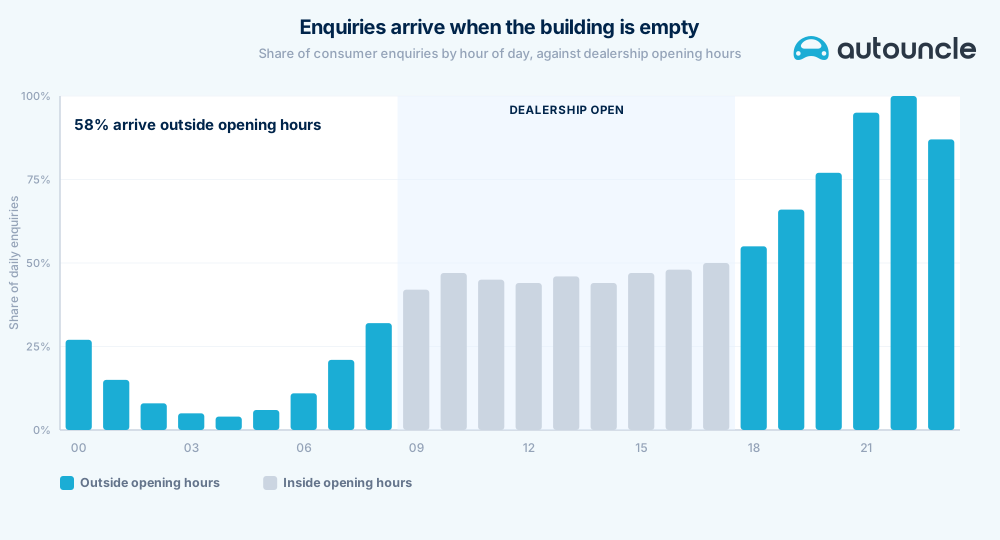
- Written enquiries get an answer at any hour, not only during opening hours.
- The reply works out what the person actually wants, a car, a service slot, a finance question, and sends it the right way.
- The salesperson picks up a conversation that has already started, with the history in front of them.
Pricing and trade-ins
- Live local listings, auction results and your own sold cars set the asking price on a used car.
- Photos the owner takes of their own car are read for dents and scratches, so the trade-in figure is close before anyone drives anywhere.
Service reminders
- Connected-car data says when one specific car is due for oil or brakes, rather than everyone getting the same letter.
- The owner gets a message with a link to a free slot and books it themselves. Nobody rings anybody.
Offers that are worth sending
- What a customer bought, and when, indicates who is near the point of changing car.
- The email names cars you have on the forecourt and a monthly payment that fits what they can spend.
Five questions to ask before you buy
Take these into the sales meeting. They sort an addition from a takeover faster than any demo.
- Which existing process is this replacing? Name it. If you cannot, you are buying an addition.
- After it is installed, what will nobody be doing any more?
- Is this chat or agentic? Does something happen when nobody opens it?
- Does it produce the same quality of qualification on a Friday evening as on a Tuesday morning?
- Which parts of the process does the vendor admit it should not touch?
About CoDriver
CoDriver is AutoUncle’s agentic assistant for dealer enquiries: it replies to written enquiries across channels around the clock, qualifies them against the dealer’s own rules, and hands the salesperson an enquiry they can act on. It identifies itself as an AI from the first message, does not quote prices, and has nothing to do with test drives or handover. It is live in Denmark, Germany and Italy.
Frequently asked questions
What is the difference between an AI chatbot and an agentic AI assistant?
A chatbot answers a visitor who is on your website and chooses to open it. An agentic assistant works inside a process without being opened: it receives enquiries from every channel, asks the missing questions, agrees appointments and hands over a qualified enquiry. The chatbot is a channel; the agentic assistant is a process.
Where should a dealership start with AI?
With a process that already exists and already feels heavy, for most dealers, handling written enquiries of varying quality. Starting from a list of what AI can do produces a purchase; starting from what is straining produces a result.
How do I tell whether an AI tool will actually help?
Ask what nobody will be doing after it is installed. If the answer is “nothing, but it will be easier,” it is an addition. If a task disappears from someone’s day, it is a takeover.
Can AI qualify car buyers as well as a salesperson?
On a good day, a salesperson qualifies better. Across a whole week, including the busy Friday evenings, a taken-over process qualifies more consistently, and consistency, not peak quality, is what determines how many enquiries get a proper answer.
Which parts of the sale should AI not handle?
The physical and the decisive: the test drive, inspecting the car, handover, and the price conversation. Those are where buyers want a person, and they are where the sale is made.
About this article
Quoted passages are from an interview with Johan Frederik Schjødt, co-founder of AutoUncle.