Summary
There is one job a car owner comes back to again and again: finding out what their car is worth. Not once in a lifetime, repeatedly. Before selling, before buying the next one, or simply out of curiosity.
“One of the key jobs I go to continuously for is to get a quote or evaluation of my car. That’s why it’s essential that any dealer has a landing page where I, as a consumer, can get a price.” — Johan Frederik Schjødt, co-founder of AutoUncle
For an independent dealer that has changed the terms. A valuation page used to be a nice extra. The online buyers have since taught consumers to expect a price within minutes, without speaking to anyone, so a dealer without one is simply not asked at the moment the owner decides to find out.
One distinction matters before going further, because two different products get sold under the same word. An internal appraisal tool is used by your buyer, on a car that is already in front of them, to arrive at a number. A consumer-facing valuation on your own website is something else entirely: the owner is at home, the car is in their driveway, nobody from your business is present, and the purpose is to get them to start the conversation with you rather than with someone else.
This article is about the second one. It is the tool that decides whether an owner deciding what to do with their car ends up in your inbox or in a competitor’s, and the criteria for judging it are not the same as for an appraisal tool, because it has to satisfy a consumer and a dealer at the same time.
So: what makes one better than another? Three things, and they are not the three usually pitched.
| Valuation page - on your website | Appraisal tool - in your yard |
|---|---|
| The owner is at home. Nobody from your business is there yet. | The car is in front of you. The conversation has already started. |
| "Who do I talk to?" | "What do I pay?" |
1. The valuation has to be market-based
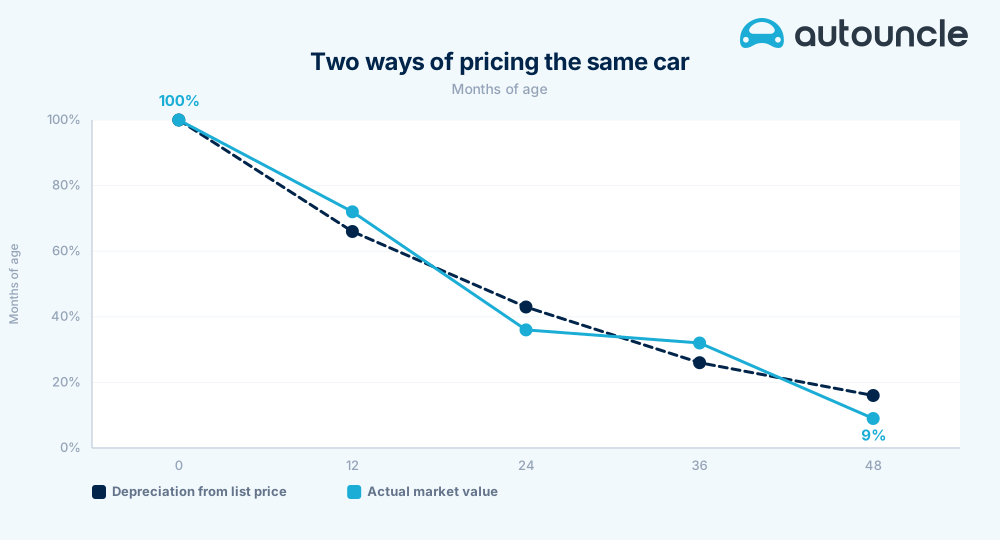
“The central thing is that the tool is market-based, that it draws on current data from the market rather than using a depreciation of new-car prices or similar.”
This is the hardest difference to see and the most expensive one to miss. A tool that works backwards from list price produces a number that looks entirely plausible: it has decimals, it sits in the right range, and it tells you nothing about what this car is worth in your market this month.
A market-based valuation is derived from vehicles actually listed and actually sold, in the country the car is in, at the mileage and specification it has. When the market moves, the number moves with it. When a model suddenly stops selling, you find out from the valuation rather than from your own stock three months later.
Ask the vendor one question: where does the number come from? A market-based system can answer it concretely. A depreciation model will answer it in adjectives.
2. The car has to be identified precisely
“It’s central that it has a good ability to identify the car being valued precisely, either from the licence plate, a guided input form built on a good model catalogue, or the VIN.”
A valuation is only ever as good as the vehicle it thinks it is valuing. Two cars carrying the same model name can differ by several thousand euros once generation, engine, gearbox and trim are accounted for. If the tool cannot resolve which variant it is actually looking at, it is pricing a different car from the one in the driveway, and doing it confidently.
There are three routes in, and on a consumer-facing page the third one carries most of the traffic. A licence plate lookup is the cleanest when the market supports it. A VIN is precise but almost nobody has it to hand at the kitchen table. Which leaves the input form, and this is where valuation pages quietly separate into good and bad.
A form is only as good as the catalogue behind it. A free-text field, or a dropdown that stops at model name, hands the owner a guess and calls it a valuation. A form built on a real vehicle catalogue, brands, models, generations, variants, engines, trim levels, all kept current as manufacturers change them, can walk an owner who knows nothing technical about their car down to the actual variant in a handful of steps. The owner experiences it as four easy questions. Underneath, it is the expensive part of the product.
So when you evaluate a valuation page, fill the form in yourself, with your own car. If it cannot get to the variant you know you own, it will not get there for your customers either.
- Which brand?
- Which model?
- Which year and generation?
- Which engine and gearbox?
- Which trim?
Four questions, one variant. Counts are illustrative.
3. Comparable cars have to come with the number
“It should always show comparable cars as part of the valuation, so the dealer can feel confident that the valuation actually reflects the market.”
This is both a quality signal and a working tool, and dealers underrate the second part.
As a quality signal: a system that shows you what it based the valuation on can be checked. One that shows only a figure asks to be trusted. If the comparables look wrong, different generation, wrong mileage band, another country, you have learned something important before you make an offer.
As a working tool: the hardest moment in buying a car is not calculating the price, it is telling the owner a number lower than the one in their head. A figure on its own invites an argument. Five genuinely comparable cars beside it turns the conversation from your opinion against theirs into a look at the same market. It also protects you later, when someone asks why you bid what you bid.
What a valuation tool is not good at
No system is equally reliable across a whole yard, and a vendor claiming otherwise is telling you something about themselves rather than about the product.
This is not particular to AutoUncle; it is structural. Market-based valuation needs comparable transactions, and the older and rarer the car, the fewer exist. Beyond that, value stops being driven by specification and starts being driven by condition, history, originality and documentation, none of which a data model can see.
For a three-year-old estate, the market is the best answer available and better than an experienced buyer’s instinct. For a thirty-year-old car, it is the other way round.
The useful conclusion is not that valuation tools are unreliable. It is that you should know which part of your intake the tool is the authority on, and which part still belongs to whoever walks out to look at the car.
A short checklist
Before signing anything, get answers to these:
- Where does the valuation figure come from, market transactions, or a depreciation curve?
- Which country’s market is it derived from, and how current is the data?
- Can a car be identified by licence plate, by VIN, and through a guided form, and does the form reach the actual variant when I test it with my own car?
- What vehicle catalogue sits behind the form, and how often is it updated as manufacturers change model ranges?
- Does every valuation come with comparable vehicles I can look at and show?
- What does it do with cars older than fifteen years, and does the vendor admit a limit?
- Does the consumer-facing valuation page work on my own domain, in my own name?
About AutoUncle
AutoUncle runs vehicle valuation across 14 European markets. Valuations are market-based, derived from vehicles currently listed and sold in the relevant country, not from new-price depreciation. Vehicles can be identified by licence plate, by VIN, or through a guided form built on AutoUncle’s own vehicle catalogue, and every valuation is delivered with the comparable vehicles behind it, both for the dealer and for the conversation with the seller.
Frequently asked questions
What is vehicle acquisition software?
Tools a dealer uses to take in purchase enquiries from consumers, identify and value the vehicle being offered, and produce an offer from it. The valuation is the core of it; everything else is process around the valuation.
What is the difference between an appraisal tool and a valuation page?
An appraisal tool is used internally, by your buyer, on a car already present. A valuation page runs on your own website and is used by the owner at home, before any contact with you. The first supports a decision you are already making; the second decides whether you get the chance to make it.
How can I tell whether a valuation is market-based?
Ask where the number comes from. A market-based system derives it from vehicles actually listed and sold in that country and can say so specifically. A system that depreciates from new price produces a calculated figure with no reference to the current market.
Does an independent dealer need their own valuation page?
Yes. Online buyers have set the expectation that a price arrives within minutes and without a conversation. Without a page where the owner can get a price themselves, the dealer is not in the running at the moment the decision is made.
Why do comparable vehicles matter?
They let you check the valuation before you act on it, and they let you show the seller the same market you are looking at rather than asking them to accept your figure.
Which cars is market-based valuation least reliable for?
Old and classic cars. Comparable transactions are scarce, and value is driven by condition, history and originality rather than by specification, which means physical inspection, not data, is decisive.